Two people work equally hard and end up with very different lives. Why do we judge ourselves by the same scoreboard?
An unsentimental, research-backed look at financial cushions, trust networks, timing, and borrowed ambitions—so you can evaluate your own life honestly without hustle formulas or cynicism.
Get the Digital Edition — $6.99Instant DRM-free PDF + EPUB · Encrypted checkout · 7-day 100% refund policy
Do any of these sound familiar?
Have you ever followed sensible career advice, worked steadily, and still wondered why someone else’s leap looked effortless while yours carried real risk?
Do you respect ambition and hard work, yet feel worn down by advice that treats every setback as a personal shortage of grit?
Have you noticed that most success stories highlight discipline while quietly omitting family savings, timing, or institutional introductions?
Are you ready for a serious, concise book that helps you see your actual coordinates clearly instead of handing you another 5:00 AM checklist?
If you nodded to even one of these, you are not lacking drive. You are simply noticing the half of the math that conventional success books leave off the page.
Why conventional success advice leaves capable adults feeling behind
Most career books treat achievement like a lab experiment where everyone starts with identical savings, identical networks, and identical economic weather.
- Edited origin stories: Popular biographies celebrate grit while omitting six-figure family checks, executive mentors, and all the peers who ran the exact same playbook and vanished.
- Borrowed risk tolerances: Advice calibrated for a debt-free twenty-four-year-old gets handed to adults carrying mortgages, student loans, and family health insurance.
- Moving reference points: Even when you earn well and keep your promises, shifting peer benchmarks turn genuine progress into quiet inadequacy.
Two Practical Tools in One Concise Edition
No padded 350-page airport filler. Everything you need to see your actual footing clearly and decide what comes next.
The Complete 10-Chapter Book
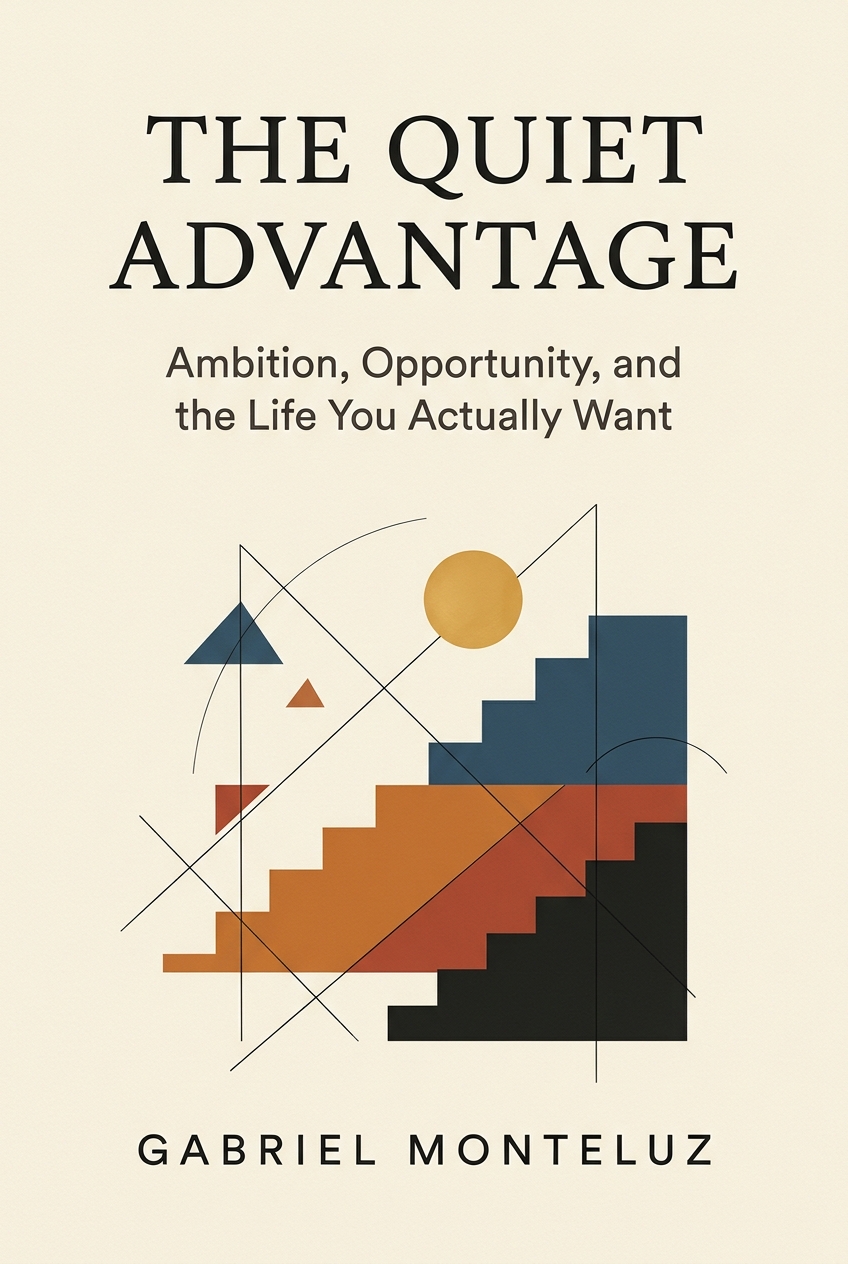
A grounded examination of achievement culture, financial starting lines, trust networks, real knowledge in the age of AI, timing and luck, borrowed ambitions, and how to balance five competing life currencies—anchored in verified real-world lives.
Six-Month Assumption Audit + Evidence Notes
Includes the non-prescriptive Six-Month Assumption Audit (Epilogue), the One-Page Starting-Point Ledger (Chapter 9), and complete methodological scope notes on every peer-reviewed study and public filing cited.
Complete Chapter-by-Chapter Syllabus
See every chapter, real-world case, and mechanism included inside before you decide.
Preface & Introduction
- Preface: Why Sunday-night 5:30 AM resolve collides with Wednesday reality—and an honest contract for a slower, clearer look at your life.
- Introduction: Two readers reading the exact same career advice from opposite starting lines, and why understanding your circumstances is not making excuses.
Part I: The Culture of Achievement
- Chapter 1 — The Achievement Machine: Why Olympic bronze medalists smile more than silver medalists, False Hope Syndrome, incomplete LinkedIn comparison, and positional scoreboards.
- Chapter 2 — The Stories We Are Sold: Katherine Raz’s Tacoma plant shop ($828,000 revenue vs. $2,000 profit and $355,512 debt), academic denominators, Bezos & Markkula cushions, and the Halo Effect.
Part II: The Hidden Foundations of Success
- Chapter 3 — The Unseen Starting Line: Sean Ichiro Manes’s 11-year $103,464 student loan timeline, liquid cash as breathing room, Chetty’s Opportunity Atlas, and fixed obligations.
- Chapter 4 — The Power of Connections: 1980 IBM & Microsoft institutional trust, Lauren Rivera’s cultural matching inside elite hiring rooms, and Granovetter/Rajkumar weak-tie bridges.
- Chapter 5 — What It Actually Means to Know Something: Karen Arnold’s 81 Illinois valedictorians, diploma signaling, generative AI’s impact on junior roles, cognitive debt, and building durable mental models.
- Chapter 6 — Timing, Luck, and the World Around You: June 2022 side by side—Bia Rebel’s 42% gas shock closure vs. Plausible Analytics hitting $1M ARR—plus recession graduation cohorts and Robert Frank’s wind blind spot.
Part III: The Psychological Price
- Chapter 7 — The Person You Think You Should Become: Julia Child’s late pivot backed by a Foreign Service cushion, Higgins’s Actual/Ideal/Ought selves, Kasser & Ryan’s extrinsic goals, and Ursula Barton’s Portland craft.
- Chapter 8 — The Exhaustion of Never Being Enough: Kristi Coulter’s 12 years at Amazon, hedonic adaptation, the 2023 Kahneman/Killingsworth income resolution, and WHO/Pencavel biological work-hour limits.
Part IV: Finding Your Own Measure + Sources
- Chapter 9 — Understand Your Own Starting Point: Dr. Jordan Grumet vs. Sean Manes running honest financial audits, Gabriele Oettingen’s Mental Contrasting (WOOP), and your one-page starting ledger.
- Chapter 10 — Choosing Your Own Measure: Five competing life currencies, Offer A ($150k / 60 hrs) vs. Offer B ($95k / 39 hrs) math, acting under uncertainty, and making peace with unchosen paths.
- Epilogue & Full Sources: Six plain questions to revisit twice a year + full peer-reviewed bibliography and primary public filings.
Grounded in Peer-Reviewed Evidence (Not Fake Testimonials)
Rather than inventing glowing reader quotes or promising guaranteed life outcomes, every argument rests on published research and verifiable public records.
Rajkumar, Brynjolfsson, Aral et al.
Experimental LinkedIn test across 2 billion ties and 600,000 job changes showing moderately weak ties causally widen job mobility.
Killingsworth, Kahneman & Mellers
Resolved the income–well-being debate: money eases hardship, yet among the least happy 20%, emotional gains flatten above ~$100k.
Chetty, Jackson et al.
Mapped cross-class economic connectedness across U.S. counties, showing how social access shapes upward mobility alongside effort.
Oreopoulos, von Wachter & Heisz
Tracked recession-year university graduates, documenting initial ~9% earnings penalties and uneven ten-year recovery paths.
Who This Book Is For
- Thoughtful adults who are doing reasonably well yet quietly question the standards they are using to judge their lives.
- Readers tired of 5:00 AM hustle formulas who also reject cynical fatalism about hard work.
- Professionals weighing concrete trade-offs around money, debt, AI-era skills, time, and family commitments.
What Makes It Different
- No invented dialogue, no composite characters, and no exaggerated transformation promises.
- Honest about what research proves and what it does not—every study’s scope is stated plainly.
- Concise by design (~16,700 words) so you actually finish it in a weekend and keep the questions for years.
Gabriel Monteluz
Gabriel Monteluz writes on behavioral science, economic starting lines, and practical decision-making for ordinary adults navigating modern work. He created Quietly Independent for readers who want clear-eyed clarity instead of loud productivity theater.
Everything Included Today
- Complete 10-chapter edition of The Quiet Advantage + Epilogue
- Six-Month Assumption Audit & One-Page Starting-Point Ledger
- Complete Peer-Reviewed Bibliography & Public-Filing Source Notes
- DRM-free PDF (desktop/tablet) + DRM-free EPUB (all e-readers)
- One-time payment ($6.99 USD) — no subscription, instant download
- Backed by our straightforward 7-day 100% refund policy
Prefer to preview first? $0 Free Sample PDF (Preface + Intro)
Frequently Asked Questions
Is this an anti-ambition book?
No. The book explicitly honors building wealth, mastering a demanding craft, and pursuing leadership—when you choose them with open eyes about what they require and cost.
How long does it take to read?
Roughly 16,700 words across 10 short chapters, an Epilogue, and full source notes. Most readers finish it in one quiet weekend.
What files do I get immediately after checkout?
You get instant access to both the typeset DRM-free PDF and DRM-free EPUB (compatible with Kindle, Apple Books, Kobo, and tablets).
Is this a subscription?
No. It is a single one-time payment of $6.99 USD with no recurring fees or upsells.
What is your refund policy, and can I preview the book first?
Every purchase is covered by a straightforward 7-day 100% refund policy—just reply to your receipt within 7 calendar days for a full refund. You can also download the $0 Free Sample PDF (Preface + Introduction) right below before buying.
Before deciding whether you’re succeeding, check whose scoreboard you’re using.
Download the complete DRM-free digital edition (PDF + EPUB) for $6.99 USD—or read the $0 Free Sample PDF first.
Get the Digital Edition — $6.99